Android IDE · on-device builds

Your phone already has the horsepower.

Pocket Studio gives it the toolchain. Real Gradle, the Kotlin and Java compilers and a C++ NDK, running as native processes on the device in your pocket. Builds run on your hardware — no cloud compute, and your code never leaves.

Read the docs Coming soon to Google Play launching shortly

Android SDK 33–37 · Gradle 7.2–9.6 · OpenJDK 17 & 21 264-module projects Product flavors and build variants — debug or release, APK or AAB clang · cmake · ninja · Python — on the phone No toolchain to assemble, no per-project workarounds

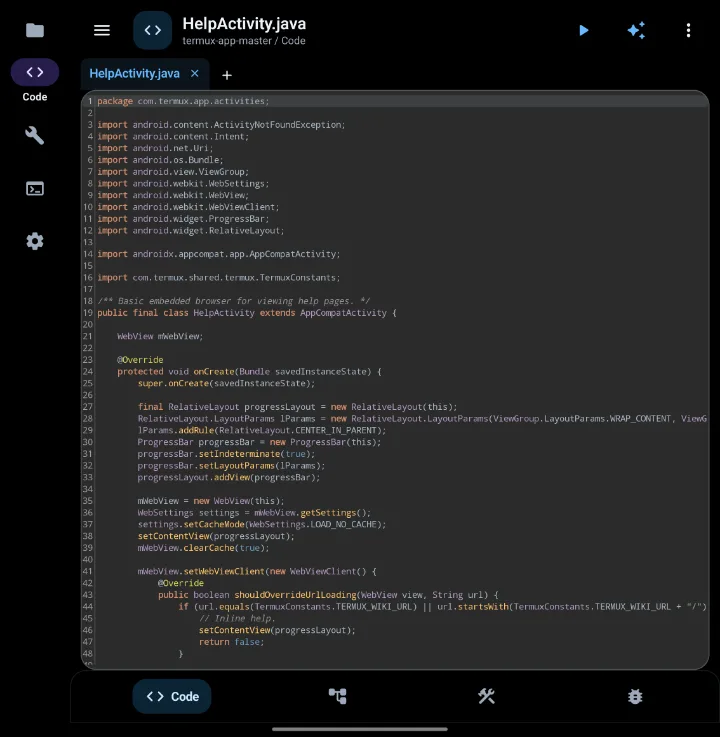
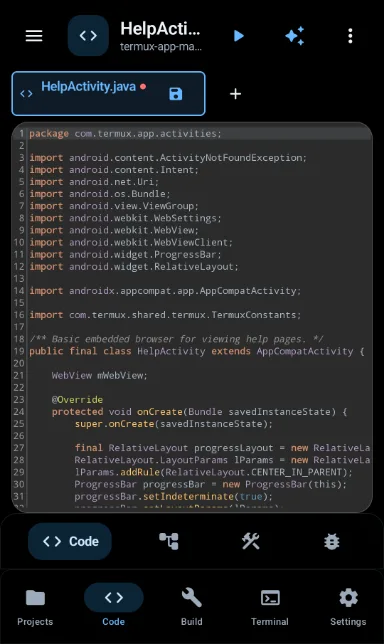
Pocket Studio on a phone: the code editor showing a Java source file from the Termux
                    project, with line numbers, syntax highlighting and a bottom bar for Projects, Code,
                    Build, Terminal and Settings.
The editor, on the device. Real project, real Java.
Built on-device
11 real open-source Android apps, during testing
Largest project
264 Gradle modules — Element X
Largest APK
349 MB signed release APK, compiled on the phone
Source uploaded
None your code stays on the device

Everything the work actually needs

Not a code viewer with syntax colours. The real toolchain, running natively.

Build for real

Gradle, the Android Gradle Plugin, the Kotlin compiler and an OpenJDK (independent build) runtime, all running as native processes on your device. Build variants and flavors, keystore management, signing, and C/C++ projects with CMake and ndk-build.
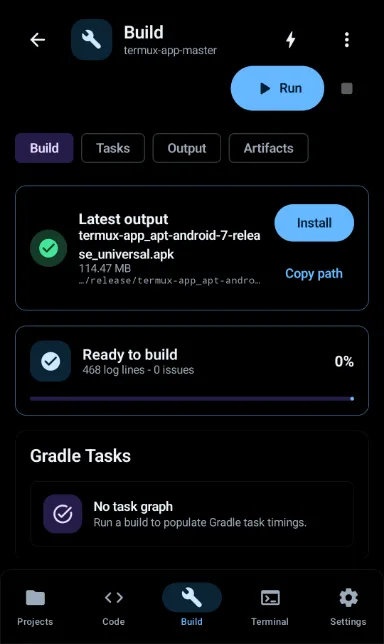
The Build screen after a successful run, listing the output artifact
                  termux-app_apt-android-7-release_universal.apk at 114.47 MB with an Install button.

A real terminal, not a toy shell

A Linux-style shell with git, python, bash, node, vim and tmux, plus a built-in Git panel for status, diff, commit and push. Project-wide search across your tree. The dev-tools userland installs on first use.
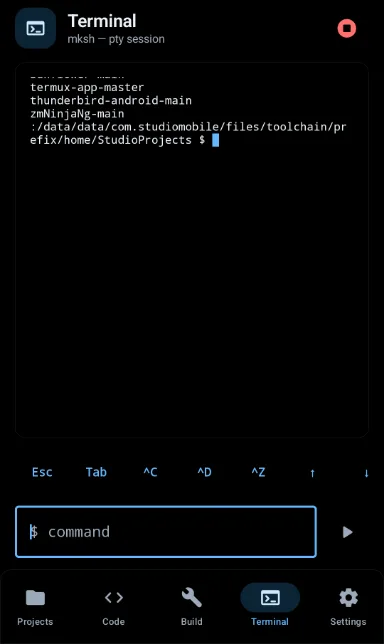
The Terminal screen listing checked-out project directories, with a command
                  input at the bottom.

An editor that keeps up

Stays smooth in large files, where mobile editors usually give up. Syntax highlighting for 20+ languages. Completion, go-to-definition, quick fixes and reformat come from real language servers for Kotlin, Java, C/C++ and Rust, plus diagnostics, quick fixes and formatting for Python — all installed on first use.

On-device debugger

A real JDWP debugger: breakpoints, call stack, frames, locals and stepping against a running app process — including an app running on a second phone over the network. Part of the Ultra plan.

Engineered for a pocket device

A phone is a small thermal envelope, so the build engine respects it: thermal guards and Battery saver / Balanced / Performance presets, and long builds are protected from Android's low-memory killer instead of being silently killed at minute nine.

AI on your own key

Generate and fix code without leaving the editor. Bring your own API key — free on every plan, talking to the provider directly, with no request passing through us. Pro adds the agent that edits, builds and fixes build errors on its own.

Git that ships with it

Clone, branch, stage, diff, commit and push from a panel built into the IDE. Sign in once and private repositories work the same on the phone as they do on a laptop.
Bigger screen

A workstation when you dock it.

Tablets, foldables and desktop-mode docks get a real multi-pane layout, with physical keyboard shortcuts and mouse support. The same project, the same toolchain, a bigger screen — not a stretched phone UI.

Shortcuts you already know work where you'd expect them: Ctrl S to save, Ctrl F to find, Ctrl B to build.

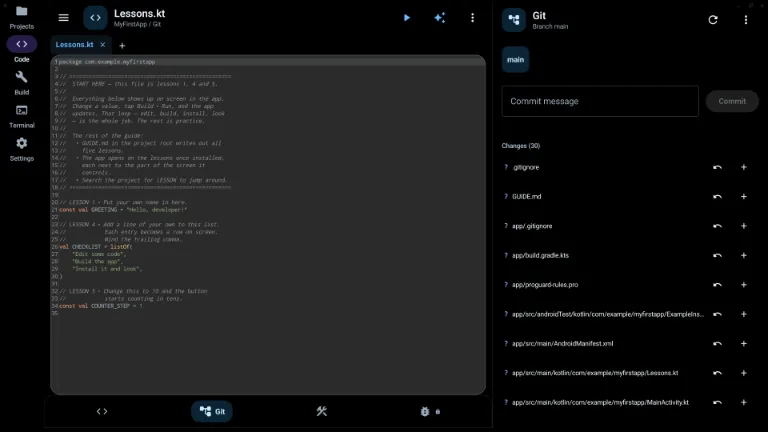
Pocket Studio on a tablet: a wide two-pane layout with an icon rail down the left
                    side for Code, Build, Terminal and Settings, and a Java file open in the editor.
The same build, on a tablet.
Pocket Studio running as a window on an external display in Android desktop mode:
                    minimise, maximise and close buttons in the title bar, a labelled icon rail for
                    Projects, Code, Build, Terminal and Settings, a Kotlin file open in the editor and
                    the Git panel beside it showing the branch, a commit box and the changed files.
Android desktop mode, on a 4K display over HDMI. A resizable window, with the interface scaled up for the larger canvas rather than left at phone size.

From idea to installed app

Three steps, and the third one produces a file you can install.

Open or create a project

Start from a template or open an existing Gradle project — clone it with the built-in Git support, or point Pocket Studio at a folder you already have on the device.

Edit with real intelligence

Completion and go-to-definition work across your whole project and its dependencies, not just the file on screen.

Build, sign, install, run

Gradle runs on the phone and produces an installable APK. Install and launch it without ever connecting to a computer.

Proof it isn't a toy

These are real open-source Android apps, built on a phone to a signed APK during development testing — not sample projects.

  • NewPipe
  • Tusky
  • AntennaPod
  • KeePassDX
  • Thunderbird
  • Telegram
  • Element X
  • Home Assistant
  • Nextcloud
  • Termux
  • Element X: 264 modules → a signed 349 MB release APK
  • full R8 optimisation, Matrix Rust SDK native libraries for four ABIs
Pocket Studio — build output
$ gradle :app:assembleDebug > Task :app:preBuild UP-TO-DATE> Task :app:compileDebugKotlin> Task :app:mergeDebugResources> Task :app:packageDebug> Task :app:assembleDebug BUILD SUCCESSFUL in 2m 41s47 actionable tasks: 39 executed, 8 up-to-date   app-debug.apk  8.2 MB   installed on this device

Illustration of on-device Gradle output. Results were produced on the development device; your device will differ — see how phones compare.

Where this sits

There are two ways to write code on a phone today. One doesn't really build, and the other builds somewhere else. This is a third.

  Mobile code editors Cloud & remote IDEs Pocket Studio
Where the build runs Usually nowhere — no Android build A server you rent The device in your hand
Where your source lives On the device Uploaded to the remote machine On the device
Gradle and the Android Gradle Plugin Rarely Yes Yes, running natively
C and C++ with the NDK No Yes Yes
Code intelligence Often highlighting only Real language servers Real language servers
JVM debugger No Yes, against the remote process Yes, on-device — Ultra plan
On a train, in a tunnel Editing works Nothing works without the link Edit, terminal and Git work; starting a build needs a brief check-in
What you're paying for The editor Metered compute, by the hour A flat plan — your own hardware does the work
A comparison of categories rather than named products; individual apps and services vary, and the good ones will beat their column. The row that matters most to us is the first one.

Plans

Every plan includes the full IDE — the editor, the terminal, Git and bring-your-own-key AI. Plans differ in how many builds you get, what you can sign, and whether you get the debugger.

Free

Try it on a real project

  • The full editor, Gradle builds and terminal
  • Monthly on-device build allowance
  • Git, and debug builds signed with your own keystore
  • Bring-your-own-key AI: chat and edits

Ultra

Phone as the primary machine

  • Everything in Pro
  • Unlimited builds, within fair use
  • Server-signed release APKs and AABs
  • The on-device JVM debugger

Pricing is set per country through Google Play and will be shown on the store listing. Subscriptions are billed by Google Play; you can cancel any time from your Play account.

Questions worth asking first

What kind of device do I need?

An arm64 (64-bit) Android phone or tablet running Android 8.0 or newer. Practically speaking, building large projects is memory-hungry work: 8 GB of RAM or more gives a comfortable experience, and you'll want several gigabytes of free storage for the toolchain, your projects and Gradle's caches.

32-bit-only devices are not supported.

Does it work offline?

Editing, browsing your code, the terminal and Git all work offline. Starting a build requires a network connection — each build checks in with our server first. That is a deliberate anti-piracy decision, and we would rather state it plainly than have you discover it on a train.

Gradle itself will also need the network the first time it resolves a project's dependencies, exactly as it does on a desktop.

Is everything included in the download?

No, and that's on purpose — a single enormous APK would be a bad trade. The app installs what you actually use, when you first use it: the language servers for Kotlin, Java, C/C++, Python and Rust (Python is diagnostics and formatting; the others add completion and go-to-definition), the command-line dev tools that back the terminal, and the native compiler toolchain for C/C++ projects.

You'll be told what is being fetched and roughly how large it is before it downloads.

Can I publish the apps I build?

Yes. Pocket Studio produces standard, signed APK and AAB artifacts. Release signing on paid tiers is done server-side with a signing key generated for your account and stored encrypted; you download the signed artifact and upload it to Google Play yourself. We never publish on your behalf.

How is the AI feature billed?

It isn't. AI is bring-your-own-key on every plan, including Free, and your requests go straight to the provider — they never pass through our servers, so we never meter them and never mark them up. You pay your provider directly, at their price.

What the paid plans add is the agent: on Pro and above it edits, builds and fixes build errors on its own, rather than only answering in chat. That is a product capability, not an AI allowance.

Will it make my phone hot?

Compiling a large project is genuinely heavy work, and a phone is a small thermal envelope — a long build will warm the device and use battery, just as it spins up the fans on a laptop. Short and incremental builds are far lighter. Building while charging, and giving the device a moment between long builds, makes for the best experience.

Do I need to root my phone?

No. Pocket Studio runs entirely as a normal Android app, within the sandbox, on a stock device. No root, no unlocked bootloader, no ADB tinkering required to use it.

Never written code before?

Pocket Studio Academy is a free course that takes you from "what is an app?" to three finished Android apps — written, compiled and installed entirely on your phone. No PC, no prior experience.

Start with something that runs

The first part builds and installs a real app on your phone before any theory. After that, Kotlin properly — types, null safety, collections, coroutines — then how Android actually works, and Jetpack Compose.

Three apps you keep

A dice game, a notes app backed by a database, and a focus timer with settings and a hand-drawn stats chart. Every chapter ships a downloadable project you can open and build to check your work.

  • 81 lessons
  • ~15 hours
  • 3 complete apps
  • 21 checkpoint projects
  • Free to start — no account needed

Your next project doesn't need a laptop.

Pocket Studio is finishing its launch preparation on Google Play.

Read the docs Coming soon to Google Play launching shortly